
Artificial Intelligence in Security: AI-Powered Threat Detection, Surveillance, and Risk Response
Artificial intelligence is rapidly transforming modern security operations by enhancing threat detection, surveillance accuracy, and real-time response. From AI-powered video analytics to predictive risk modeling, security teams are using AI to identify threats faster, reduce false alarms, and improve situational awareness.
Artificial intelligence is reshaping how security teams detect threats, monitor environments, and respond to incidents. AI-powered security systems enable:
- Real-time weapon and threat detection
- Reduced false alarms through intelligent video analytics
- Facial and license plate recognition
- Faster analysis of large surveillance datasets
- Predictive risk identification and response
These capabilities improve accuracy, speed, and situational awareness across physical security operations.
One would be hard-pressed to find a topic in industries as popular today as that of Artificial Intelligence (AI). Pundits have categorized AI and its domestic and global impact as significant as those seen during the industrial and computer revolutions. In today’s blog, we focus on the basic principles of AI, its definition in plain language, practical applications within our society, and a first glance at its impact on the security industry, especially as it relates to AI security systems and emerging technologies shaping the future.
What Is Artificial Intelligence?
AI has many definitions, which tend to add to confusion on the subject; some consider it a technology that allows computers and machines to think intelligently. Some see it as a system that replaces human labor, allowing for enhanced efficiencies. Others see it as a system’s ability to correctly interpret external data, to learn from such data, and to use those learnings to achieve specific goals and tasks through flexible adaptation (1).
Different Types of Artificial Intelligence
AI scholars tend to generally distinguish it into two types: weak (also known as weak AI), which is generally used to perform narrow tasks like Siri internet searches or self-driving vehicles. The second type is characterized as strong (AI) or artificial general intelligence (AGI), which provides systems or machines the ability to learn tasks and address problems.
How is artificial intelligence used in physical security operations?
Artificial intelligence is used in physical security operations to monitor video surveillance systems, detect weapons or suspicious activity, recognize faces and license plates, reduce false alarms, and analyze large volumes of security data using predictive analytics.
Real World Applications of Artificial Intelligence
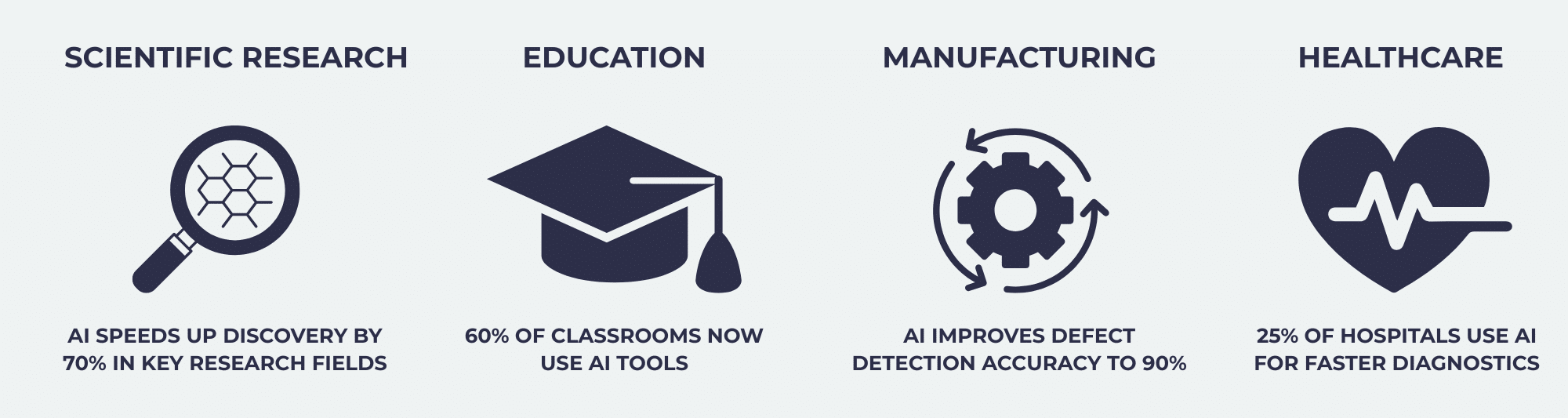
As the use of AI steadily increases, there have been areas that have already proven to show significant practical applications for humans, including healthcare, scientific research, education, and manufacturing. In healthcare, AI is able to analyze enormous databases to more efficiently and effectively provide diagnoses, develop personalized treatment plans, and assist in surgical procedures. Understanding the current labor shortage among healthcare professionals and both its financial and care impact, such tools are clearly welcome. Likewise, labor shortages within the fields of education have served as an opportunity to fill gaps. For example, asking any college student if it is easy to find a tutor when needed, the answer is generally no. In such cases, virtual tutors have proven to be useful tools, reducing human error and improving decision-making.
How does AI improve threat detection in security?
AI improves threat detection by continuously analyzing surveillance camera feeds, identifying weapons or abnormal behavior, and alerting security teams in real time. By using machine learning and computer vision, AI-powered security systems detect threats faster, reduce human error, and improve response accuracy across physical security operations.
How AI Is Transforming Threat Detection and Response
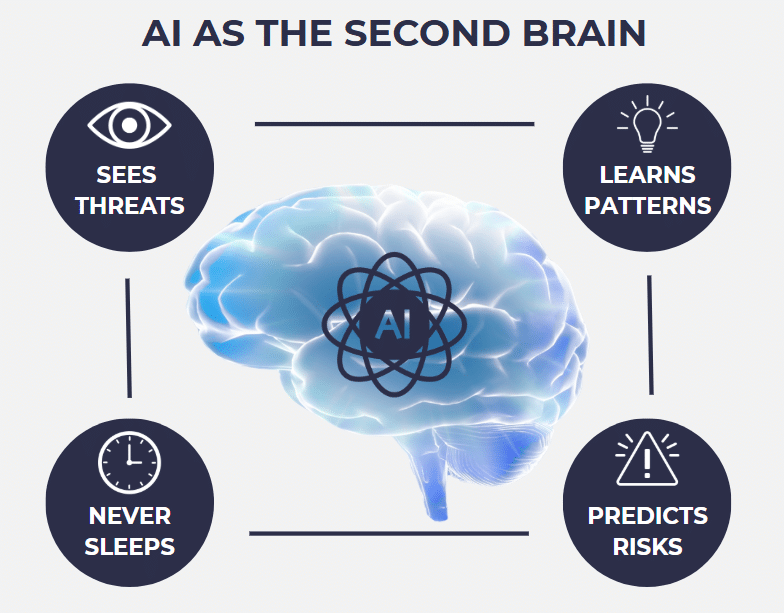
Security is an area that requires the utmost professionalism, training, equipment, careful planning, coordination, experience, and execution. Businesses, governments, or organizations that do not adhere to such a recipe are prone to significant financial, programmatic, and human implications. Even within organizations with well-structured security methodologies, there are opportunities for continuous improvement, allowing for enhanced risk mitigation. At Silver Star Protection Group, we see AI and its impact on what we do and how we do it as another brain, a brain unlike any before, one that can learn continuously, adapt, predict, does not get tired, and becomes one of the most unique tools within our extensive arsenal. This is the foundation of modern AI-powered surveillance and AI-enabled threat detection.
AI as the Second Brain in Security Operations
- Sees Threats: Continuously monitors live video feeds to detect weapons, hazards, and suspicious behavior
- Learns Patterns: Analyzes historical incidents to identify emerging threat trends
- Predicts Risks: Uses predictive analytics to anticipate incidents before escalation
- Never Sleeps: Operates 24/7 without fatigue or human error
At Silver Star, we have been able to harness AI to augment our success in security operations in multiple ways, including:
- Monitoring and detecting guns within an IP camera’s field of view using advanced AI gun detection technology.
- Integrating gun detection with immediate alert and response protocols through easy-to-use dashboards.
- Maximized video optimization, ensuring low false-positive rates and accuracy through enhanced video analytics security.
- Maximized data analysis and efficiency protocols powered by predictive security analytics.
- Automated facial recognition security solutions eliminating manual watchlists and evaluations.
- Suspicious behavior detection supported by anomaly detection in security.
- False alarm detection system reducing false alarm positives by up to 99.95%.
- Accurately pinpoint sub-section areas within a map to refine searches and obtain actionable insights and anticipated patterns and/or reactions.
- Apply proprietary algorithms to detect specific objects including but not limited to abandoned objects, knives, and litter.
- Detect smoke, fire, and a wide variety of hazardous environments both inside and outside.
- Detect people or vehicles in a specific zone at a specific time through existing infrastructure 24/7.
- Locate identify and track specific license plates and vehicles.
- Identification and notification of anomalous events or behavior (i.e.: Aggressive behavior, slip & falls, vandalism etc.)
What role does AI play in modern surveillance systems?
AI enhances modern surveillance systems by applying computer vision and machine learning to video monitoring, allowing security teams to identify threats, track individuals or vehicles, and respond to incidents across facilities, campuses, and municipal environments.
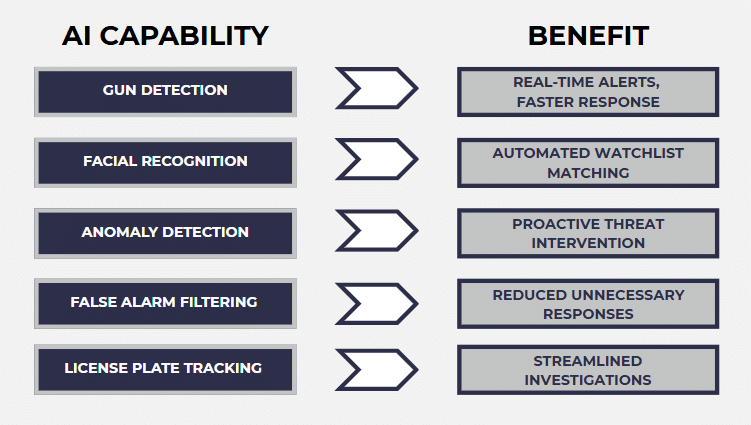
AI Security Capabilities and Operational Benefits
- Gun Detection: Real-time alerts and faster emergency response
- Facial Recognition: Automated watchlist matching and suspect identification
- Anomaly Detection: Proactive threat intervention
- False Alarm Filtering: Reduced unnecessary dispatches
- License Plate Tracking: Streamlined investigations and vehicle tracking
Case Study Example: How AI Could Enhance Urban Security Investigations
This example illustrates how AI-powered security technologies could support investigations alongside traditional law enforcement methods.
A high-profile crime in New York City last December highlights how AI could aid law enforcement. Brian Thompson, the 50-year-old CEO of United Healthcare, was shot and killed in broad daylight in Manhattan. The suspect, 26-year-old Ivy League graduate Luigi Mangione, fled the scene and evaded capture for five days despite the city’s extensive surveillance network. He was eventually found at a McDonald’s nearly 500 kilometers away, carrying the murder weapon, a passport, and $10,000 in cash.
This case is not a critique of law enforcement efforts but underscores the potential for improvement even within strong security systems. NYC’s 18,000 surveillance cameras produce massive amounts of footage, making it nearly impossible for human officers to process quickly. For five days, little actionable data emerged until a McDonald’s employee recognized Mangione from the news.
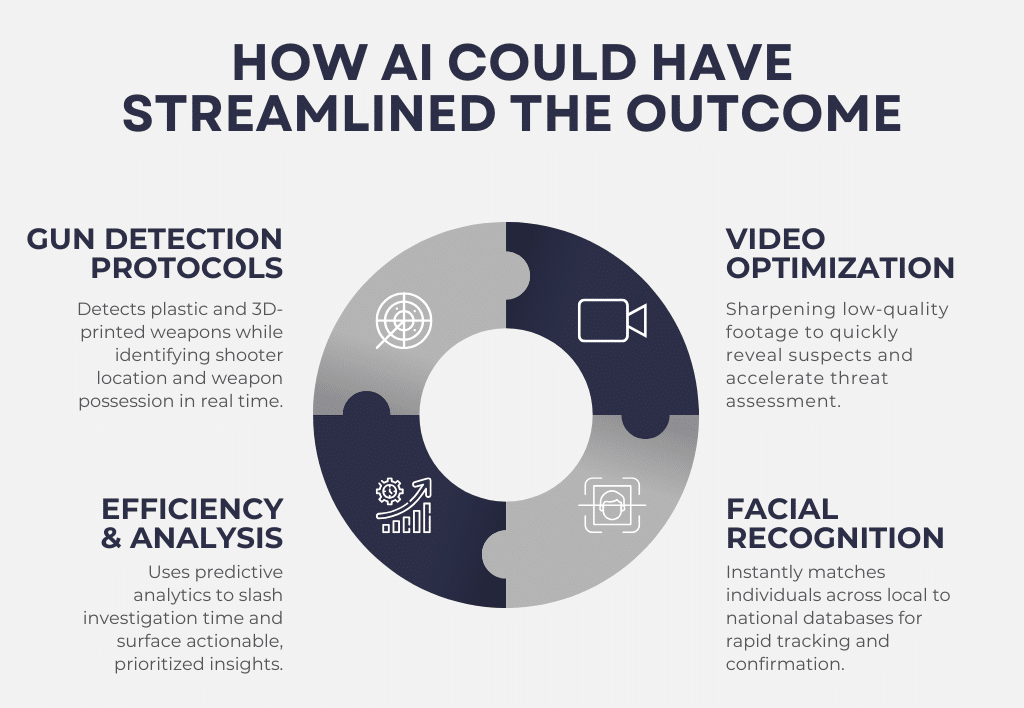
With hindsight, it’s clear that AI could have dramatically streamlined the investigation, efficiently analyzing video footage and identifying key leads faster. This case illustrates how AI can enhance future law enforcement efforts.
- Gun Detection and Related Protocols – Understanding that the shooting was committed using a 3-D printed (Plastic gun) made by the suspect, metal detectors would prove useless, and law enforcement had no idea if the suspect still had the weapon until his apprehension. AI may have been able to detect the type of weapon, immediately identify the location of the shooting, and whether the suspect had it in his possession.
- Maximized Video Optimization Ensuring Low False-Positive Rates and Accuracy – The quality of the suspect video was not high; as such, AI may have been able to enhance its quality and reduce the time between crime and apprehension.
- Maximized Data Analysis and Efficiency Protocols – All information provided to date clearly indicates that law enforcement conducted their investigation using traditional methods without the use of AI. AI may have dramatically collapsed the timeframe, manpower necessary, and cost associated with several components of the investigation, including but not limited to data analysis and recommended action steps based on predictive analytics.
- Facial Recognition/Watchlist Functionality – The ability to almost instantly assess databases locally, regionally, and nationally in just such a situation to help identify the shooter and seek his location more efficiently.
In conclusion, we hope that this introduction to AI and its practical examples within the security industry, including that of municipal policing, serves as an inspiration to talk about what we at Silver Star see as one of the most revolutionary technologies in our industry. Learn more by visiting our Security System Integrations page.
AI Security Capabilities at Silver Star Protection Group
- AI-powered video surveillance
- Real-time gun and weapon detection
- Facial recognition & watchlist matching
- License plate recognition
- Anomaly and behavior detection
- False alarm reduction technology
- Predictive risk analytics
- 24/7 monitoring and response integration
Frequently Asked Questions
How is artificial intelligence used in security systems?
- AI is used to analyze surveillance footage, detect weapons or suspicious behavior, recognize faces and vehicles, reduce false alarms, and predict security risks in real time.
What is AI-powered threat detection?
- AI-powered threat detection uses machine learning and video analytics to identify threats faster and more accurately than manual monitoring.
How does AI reduce false alarms in security monitoring?
- AI filters non-threatening motion and environmental noise, reducing false alarms by up to 99% and improving response efficiency.
Is AI surveillance monitored by humans?
- Yes. AI enhances human teams by flagging high-risk events, which are reviewed and acted on by trained professionals.
REFERENCES
1.Kaplan A, Haenlein M. Siri, Siri, in my hand: Who’s the fairest in the land? On the interpretations, illustrations, and implications of artificial intelligence. Business Horizons. 2019;62:15–25. [Google Scholar]